[Skip to main content](https://www.nike.com#skip-to-content)
- [](https://www.nike.com/il/jordan)
- [Find a Store](https://www.nike.com/il/retail)
- [Help](https://www.nike.com/il/help)
[Help](https://www.nike.com/il/help)
- [Order Status](https://www.nike.com/il/orders)
- [Dispatch and Delivery](https://www.nike.com/il/help/a/shipping-delivery-gs)
- [Returns](https://www.nike.com/il/help/a/returns-policy-gs)
- [Contact Us](https://www.nike.com/il/help/#contact)
- [Privacy Policy](https://agreementservice.svs.nike.com/il/en_gb/rest/agreement?agreementType=privacyPolicy&uxId=com.nike.unite&country=IL&language=en&requestType=redirect)
- [Terms of Sale](https://www.eshopworld.com/shoppers/help/retailer/nike/terms-and-conditions-of-sale-en/)
- [Terms of Use](https://agreementservice.svs.nike.com/il/en_gb/rest/agreement?agreementType=termsOfUse&uxId=com.nike.unite&country=IL&language=en&requestType=redirect)
- [Send Us Feedback](https://www.nike.com#site-feedback)
- [Join Us](https://www.nike.com/il/membership)
- [Sign In](https://www.nike.com/il/register)
[](https://www.nike.com/il/)
- [New](https://www.nike.com/il/w/new-3n82y)
- [New](https://www.nike.com/il/w/new-3n82y)
- [New Arrivals](https://www.nike.com/il/w/new-3n82y)
- [Best Sellers](https://www.nike.com/il/w/best-76m50)
- [SNKRS Launch Calendar](https://www.nike.com/gb/launch/upcoming)
- [Highlights](https://www.nike.com/il/w/new-just-in-3apgqz3n82y)
- [Jordan: Love Letter Collection](https://www.nike.com/il/w/love-letter-7xkbw)
- [Best of Jordan](https://www.nike.com/il/w/best-of-jordan-brand-j0oa)
- [Jordan Fleece](https://www.nike.com/il/w/jordan-fleece-37eefz4xh6q)
- [Football: New Club Kits 26/27](https://www.nike.com/il/w/club-football-teams-6fu9q)
- [After Dark Tour London](https://www.nike.com/il/w/after-dark-tour-6bo5l)
- [Trending](https://www.nike.com/il/w/best-76m50)
- [Hybrid Training](https://www.nike.com/il/w/hybrid-training-8wvhh)
- [Marathon Shoes](https://www.nike.com/il/w/marathon-distance-shoes-6vbyfzy7ok)
- [Elite Football Boots](https://www.nike.com/il/w/elite-football-shoes-1gdj0z9vmnhzy7ok)
- [Sportswear Clothing](https://www.nike.com/il/w/sportswear-clothing-43h4uz6ymx6)
- [Waterproof Running Jackets](https://www.nike.com/il/w/water-resistant-running-jackets-gilets-37v7jz50r7yzo08u)
- [Brands](https://www.nike.com/il/w/37eefz43h4uz93bsdzpgd6)
- [Nike Sportswear](https://www.nike.com/il/w/lifestyle-13jrm)
- [ACG: All Conditions Gear](https://www.nike.com/il/acg)
- [Jordan](https://www.nike.com/il/w/jordan-37eef)
- [Kobe](https://www.nike.com/il/w/kobe-pgd6)
- [NOCTA](https://www.nike.com/il/w/nocta-25nhb)
- [Men](https://www.nike.com/il/men)
- [Highlights](https://www.nike.com/il/w/new-mens-3n82yznik1)
- [New Arrivals](https://www.nike.com/il/w/new-mens-3n82yznik1)
- [Best Sellers](https://www.nike.com/il/w/mens-best-76m50znik1)
- [Streetwear Clothing](https://www.nike.com/il/w/streetwear-clothing-97qn8)
- [Football: New Club Kits 26/27](https://www.nike.com/il/w/club-football-teams-6fu9q)
- [Clothing Essentials](https://www.nike.com/il/w/mens-essentials-4jjpuznik1)
- [Shoes](https://www.nike.com/il/w/mens-shoes-nik1zy7ok)
- [All Shoes](https://www.nike.com/il/w/mens-shoes-nik1zy7ok)
- [Lifestyle](https://www.nike.com/il/w/mens-lifestyle-shoes-13jrmznik1zy7ok)
- [Jordan](https://www.nike.com/il/w/mens-jordan-shoes-37eefznik1zy7ok)
- [Running](https://www.nike.com/il/w/mens-running-shoes-37v7jznik1zy7ok)
- [Football](https://www.nike.com/il/w/mens-football-shoes-1gdj0znik1zy7ok)
- [Basketball](https://www.nike.com/il/w/mens-basketball-shoes-3glsmznik1zy7ok)
- [Training and Gym](https://www.nike.com/il/w/mens-training-gym-shoes-58jtoznik1zy7ok)
- [Skateboarding](https://www.nike.com/il/w/mens-skateboarding-shoes-8mfrfznik1zy7ok)
- [Custom Shoes](https://www.nike.com/il/w/mens-nike-by-you-shoes-6ealhznik1zy7ok)
- [Clothing](https://www.nike.com/il/w/mens-clothing-6ymx6znik1)
- [All Clothing](https://www.nike.com/il/w/mens-clothing-6ymx6znik1)
- [Hoodies and Sweatshirts](https://www.nike.com/il/w/mens-hoodies-sweatshirts-6riveznik1)
- [Jackets](https://www.nike.com/il/w/mens-jackets-gilets-50r7yznik1)
- [Tracksuits](https://www.nike.com/il/w/mens-tracksuits-1ll2wznik1)
- [Trousers and Tights](https://www.nike.com/il/w/mens-trousers-tights-2kq19znik1)
- [Tops and T-Shirts](https://www.nike.com/il/w/mens-tops-t-shirts-9om13znik1)
- [Shorts](https://www.nike.com/il/w/mens-shorts-38fphznik1)
- [Kits and Jerseys](https://www.nike.com/il/w/mens-football-kits-jerseys-1gdj0z3a41eznik1)
- [Accessories](https://www.nike.com/il/w/mens-accessories-equipment-awwpwznik1)
- [Sport](https://www.nike.com/il/w/mens-performance-3k7dgznik1)
- [Running](https://www.nike.com/il/running)
- [Football](https://www.nike.com/il/football)
- [Basketball](https://www.nike.com/il/basketball)
- [Training and Gym](https://www.nike.com/il/training)
- [Tennis](https://www.nike.com/il/tennis)
- [Skateboarding](https://www.nike.com/il/w/mens-skateboarding-8mfrfznik1)
- [Golf](https://www.nike.com/il/golf)
- Brands
- [Nike Sportswear](https://www.nike.com/il/sportswear)
- [ACG: All Conditions Gear](https://www.nike.com/il/acg)
- [Jordan](https://www.nike.com/il/w/mens-jordan-37eefznik1)
- [Kobe](https://www.nike.com/il/w/mens-kobe-nik1zpgd6)
- [NOCTA](https://www.nike.com/il/w/mens-nocta-25nhbznik1)
- [Women](https://www.nike.com/il/women)
- [Highlights](https://www.nike.com/il/w/new-womens-3n82yz5e1x6)
- [New Arrivals](https://www.nike.com/il/w/new-womens-3n82yz5e1x6)
- [Best Sellers](https://www.nike.com/il/w/womens-best-5e1x6z76m50)
- [Nike Fleece Essentials](https://www.nike.com/il/w/nike-studio-fleece-s531)
- [Seasonal Clothing Packs](https://www.nike.com/il/w/seasonal-clothing-packs-9yawh)
- [Football Player Edition: Sam Kerr](https://www.nike.com/il/w/sam-kerr-4mbmv)
- [Clothing Essentials](https://www.nike.com/il/w/womens-essentials-4jjpuz5e1x6)
- [After Dark Tour London](https://www.nike.com/il/w/after-dark-tour-6bo5l)
- [Shoes](https://www.nike.com/il/w/womens-shoes-5e1x6zy7ok)
- [All Shoes](https://www.nike.com/il/w/womens-shoes-5e1x6zy7ok)
- [Lifestyle](https://www.nike.com/il/w/womens-lifestyle-shoes-13jrmz5e1x6zy7ok)
- [Jordan](https://www.nike.com/il/w/womens-jordan-shoes-37eefz5e1x6zy7ok)
- [Running](https://www.nike.com/il/w/womens-running-shoes-37v7jz5e1x6zy7ok)
- [Training and Gym](https://www.nike.com/il/w/womens-training-gym-shoes-58jtoz5e1x6zy7ok)
- [Football](https://www.nike.com/il/w/womens-football-shoes-1gdj0z5e1x6zy7ok)
- [Custom Shoes](https://www.nike.com/il/w/womens-nike-by-you-shoes-5e1x6z6ealhzy7ok)
- [Clothing](https://www.nike.com/il/w/womens-clothing-5e1x6z6ymx6)
- [All Clothing](https://www.nike.com/il/w/womens-clothing-5e1x6z6ymx6)
- [Hoodies and Sweatshirts](https://www.nike.com/il/w/womens-hoodies-sweatshirts-5e1x6z6rive)
- [Jackets](https://www.nike.com/il/w/womens-jackets-gilets-50r7yz5e1x6)
- [Trousers](https://www.nike.com/il/w/womens-trousers-tights-2kq19z5e1x6)
- [Leggings](https://www.nike.com/il/w/womens-tights-leggings-29sh2z5e1x6)
- [Matching Sets](https://www.nike.com/il/w/womens-matching-sets-2lukpz5e1x6)
- [Tops and T-Shirts](https://www.nike.com/il/w/womens-tops-t-shirts-5e1x6z9om13)
- [Shorts](https://www.nike.com/il/w/womens-shorts-38fphz5e1x6)
- [Sports Bras](https://www.nike.com/il/w/womens-sports-bras-40qgmz5e1x6)
- [Accessories](https://www.nike.com/il/w/womens-accessories-equipment-5e1x6zawwpw)
- [Sport](https://www.nike.com/il/w/womens-performance-3k7dgz5e1x6)
- [Training and Gym](https://www.nike.com/il/training)
- [Running](https://www.nike.com/il/running)
- [Football](https://www.nike.com/il/football)
- [Basketball](https://www.nike.com/il/basketball)
- [Tennis](https://www.nike.com/il/tennis)
- [Skateboarding](https://www.nike.com/il/w/womens-skateboarding-5e1x6z8mfrf)
- [Golf](https://www.nike.com/il/golf)
- Brands
- [NikeSKIMS](https://www.nike.com/il/nikeskims)
- [Nike Sportswear](https://www.nike.com/il/sportswear)
- [ACG: All Conditions Gear](https://www.nike.com/il/acg)
- [Jordan](https://www.nike.com/il/w/womens-jordan-37eefz5e1x6)
- [Kobe](https://www.nike.com/il/w/womens-kobe-5e1x6zpgd6)
- [Kids](https://www.nike.com/il/kids)
- [Highlights](https://www.nike.com/il/w/new-kids-3n82yzv4dh)
- [New Arrivals](https://www.nike.com/il/w/new-kids-3n82yzv4dh)
- [Best Sellers](https://www.nike.com/il/w/kids-best-76m50zv4dh)
- [Teen Destination](https://www.nike.com/il/teens)
- [Nike x LEGO® Collection](https://www.nike.com/il/lego)
- [Clothing Essentials](https://www.nike.com/il/w/kids-essentials-4jjpuzv4dh)
- [Shoes](https://www.nike.com/il/w/kids-shoes-v4dhzy7ok)
- [All Shoes](https://www.nike.com/il/w/kids-shoes-v4dhzy7ok)
- [Lifestyle](https://www.nike.com/il/w/kids-lifestyle-shoes-13jrmzv4dhzy7ok)
- [Jordan](https://www.nike.com/il/w/kids-jordan-shoes-37eefzv4dhzy7ok)
- [Football](https://www.nike.com/il/w/kids-football-shoes-1gdj0zv4dhzy7ok)
- [Running](https://www.nike.com/il/w/kids-running-shoes-37v7jzv4dhzy7ok)
- [Basketball](https://www.nike.com/il/w/kids-basketball-shoes-3glsmzv4dhzy7ok)
- [Physical Education](https://www.nike.com/il/w/kids-performance-shoes-3k7dgzv4dhzy7ok)
- [Clothing](https://www.nike.com/il/w/kids-clothing-6ymx6zv4dh)
- [All Clothing](https://www.nike.com/il/w/kids-clothing-6ymx6zv4dh)
- [Hoodies and Sweatshirts](https://www.nike.com/il/w/kids-hoodies-sweatshirts-6rivezv4dh)
- [Jackets](https://www.nike.com/il/w/kids-jackets-gilets-50r7yzv4dh)
- [Tracksuits](https://www.nike.com/il/w/kids-tracksuits-1ll2wzv4dh)
- [Trousers and Leggings](https://www.nike.com/il/w/kids-trousers-tights-2kq19zv4dh)
- [Matching Sets](https://www.nike.com/il/w/kids-matching-sets-2lukpzv4dh)
- [Tops and T-Shirts](https://www.nike.com/il/w/kids-tops-t-shirts-9om13zv4dh)
- [Shorts](https://www.nike.com/il/w/kids-shorts-38fphzv4dh)
- [Kits & Jerseys](https://www.nike.com/il/w/kids-football-kits-jerseys-1gdj0z3a41ezv4dh)
- [Accessories](https://www.nike.com/il/w/kids-accessories-equipment-awwpwzv4dh)
- [Kids by age](https://www.nike.com/il/w/kids-v4dh)
- [Teens (13–17 years)](https://www.nike.com/il/w/teen-collection-6hgue)
- [Older Kids (7–12 years)](https://www.nike.com/il/w/older-kids-agibjzv4dh)
- [Younger Kids (3–7 years)](https://www.nike.com/il/w/little-kids-6dacezv4dh)
- [Baby & Toddler (0–3 years)](https://www.nike.com/il/w/baby-toddlers-kids-2j488zv4dh)
- [Sport](https://www.nike.com/il/w/kids-performance-3k7dgzv4dh)
- [Running](https://www.nike.com/il/w/kids-running-37v7jzv4dh)
- [Football](https://www.nike.com/il/w/kids-football-1gdj0zv4dh)
- [Basketball](https://www.nike.com/il/w/kids-basketball-3glsmzv4dh)
- [Physical Education](https://www.nike.com/il/w/kids-training-gym-58jtozv4dh)
- [Skateboarding](https://www.nike.com/il/w/skateboarding-8mfrf)
- [Sport](https://www.nike.com/il/lockerroom)
- [Highlights](https://www.nike.com/il/w/new-performance-3k7dgz3n82y)
- [New Arrivals](https://www.nike.com/il/w/new-performance-3k7dgz3n82y)
- [Best Sellers](https://www.nike.com/il/w/best-performance-3k7dgz76m50)
- [Jordan Basketball](https://www.nike.com/il/w/jordan-basketball-37eefz3glsm)
- [Football: New Club Kits 26/27](https://www.nike.com/il/w/club-football-teams-6fu9q)
- [Discover: Nike Hybrid RN](https://www.nike.com/il/w/hybrid-training-8wvhh)
- [Running](https://www.nike.com/il/running)
- [All Running](https://www.nike.com/il/w/running-37v7j)
- [Shoes](https://www.nike.com/il/w/running-shoes-37v7jzy7ok)
- [Clothing](https://www.nike.com/il/w/running-clothing-37v7jz6ymx6)
- [Accessories](https://www.nike.com/il/w/running-accessories-equipment-37v7jzawwpw)
- [Football](https://www.nike.com/il/football)
- [All Football](https://www.nike.com/il/w/football-1gdj0)
- [Shoes](https://www.nike.com/il/w/football-shoes-1gdj0zy7ok)
- [Clothing](https://www.nike.com/il/w/football-clothing-1gdj0z6ymx6)
- [Accessories](https://www.nike.com/il/w/football-accessories-equipment-1gdj0zawwpw)
- [Training and Gym](https://www.nike.com/il/training)
- [All Training and Gym](https://www.nike.com/il/w/training-gym-58jto)
- [Shoes](https://www.nike.com/il/w/training-gym-shoes-58jtozy7ok)
- [Clothing](https://www.nike.com/il/w/training-gym-clothing-58jtoz6ymx6)
- [Accessories](https://www.nike.com/il/w/training-gym-accessories-equipment-58jtozawwpw)
- [More Sports](https://www.nike.com/il/w/performance-3k7dg)
- [All Sport](https://www.nike.com/il/w/performance-3k7dg)
- [Basketball](https://www.nike.com/il/basketball)
- [Outdoor](https://www.nike.com/il/w/acg-93bsd)
- [Tennis](https://www.nike.com/il/tennis)
- [Nike SB](https://www.nike.com/il/w/skateboarding-8mfrf)
- [Golf](https://www.nike.com/il/golf)
- [Swimming](https://www.nike.com/il/w/swimming-3c2dj)
- [NikeSKIMS](https://www.nike.com/il/nikeskims)
- [NikeSKIMS Guides](https://www.nike.com/il/nikeskims-lookbook)
- [NikeSKIMS Lookbook](https://www.nike.com/il/nikeskims-lookbook)
- [NikeSKIMS Bra Guide](https://www.nike.com/il/nikeskims-bra-guide)
- [NikeSKIMS Collection Guide](https://www.nike.com/il/nikeskims-collection-guide)
- [Clothing](https://www.nike.com/il/w/nikeskims-b2asd)
- [All Clothing](https://www.nike.com/il/w/nikeskims-clothing-6ymx6zb2asd)
- [Bras](https://www.nike.com/il/w/nikeskims-sports-bras-40qgmzb2asd)
- [Tops and Tanks](https://www.nike.com/il/w/nikeskims-tops-t-shirts-9om13zb2asd)
- [Leggings](https://www.nike.com/il/w/nikeskims-tights-leggings-29sh2zb2asd)
- [Shorts](https://www.nike.com/il/w/nikeskims-shorts-38fphzb2asd)
- [Shoes](https://www.nike.com/il/w/nikeskims-shoes-b2asdzy7ok)
- [Accessories](https://www.nike.com/il/w/nikeskims-accessories-equipment-awwpwzb2asd)
- [Collections](https://www.nike.com/il/nikeskims-collection-guide)
- [All Collections](https://www.nike.com/il/w/nikeskims-b2asd)
- [Satin Shine](https://www.nike.com/il/w/nikeskims-satin-shine-97fc5)
- [Matte](https://www.nike.com/il/w/nikeskims-nikeskims-matte-5s3enzb2asd)
- [Airy](https://www.nike.com/il/w/nikeskims-nikeskims-airy-5c1qqzb2asd)
- [Ribbed Seamless](https://www.nike.com/il/w/nikeskims-nikeskims-seamless-6lh4szb2asd)
- [Studio Stretch](https://www.nike.com/il/w/nikeskims-studio-stretch-admbq)
- [Stretch Nylon](https://www.nike.com/il/w/nikeskims-stretch-nylon-7sut9)
- [Weightless](https://www.nike.com/il/w/nikeskims-nikeskims-weightless-4csx8zb2asd)
- [Shop By Color](https://www.nike.com/il/w/nikeskims-b2asd)
- [Obsidian](https://www.nike.com/il/w/nikeskims-black-90poyzb2asd)
- [Dark Sepia](https://www.nike.com/il/w/nikeskims-dark-sepia-81pvm)
- [Phoenix](https://www.nike.com/il/w/nikeskims-phoenix-1jhtj)
- [Ivory](https://www.nike.com/il/w/nikeskims-white-4g797zb2asd)
- [Citrine](https://www.nike.com/il/w/nikeskims-yellow-ayp69zb2asd)
- [Carob](https://www.nike.com/il/w/nikeskims-brown-557pqzb2asd)
Cancel
Cancel
Popular Search Terms
[basketball shoes](https://www.nike.com/il/w?q=basketball%20shoes&vst=basketball%20shoes)[football shoes](https://www.nike.com/il/w?q=football%20shoes&vst=football%20shoes)[ja 3](https://www.nike.com/il/w?q=ja%203&vst=ja%203)[jordan](https://www.nike.com/il/w?q=jordan&vst=jordan)[air force 1](https://www.nike.com/il/w?q=air%20force%201&vst=air%20force%201)[mind](https://www.nike.com/il/w?q=mind&vst=mind)[nike mind shoes](https://www.nike.com/il/w?q=nike%20mind%20shoes&vst=nike%20mind%20shoes)[kobe](https://www.nike.com/il/w?q=kobe&vst=kobe)
[](https://www.nike.com/il/favorites "Favourites")[](https://www.nike.com/il/cart "Bag Items: 0")
# 10 Trainer-Approved Warm-up Exercises for a Stronger Leg Day
##### Sports & Activity
Learn why warming up is essential for leg day, how it boosts performance and injury prevention, and which trainer-approved exercises create the most effective routine.
Last updated: 9 January 2026
10 min read
## Warm-up principles:
- Increase core temperature
- Mobilise joints
- Activate glutes and core
- Rehearse leg-day movement patterns
Whether leg-training day fills you with excitement or dread, the kick-off is likely the same: You want to get to your chosen exercises as quickly as possible. However, making the effort to warm up first not only makes your session more effective, but it also tends to lower your risk of injury and help you get into the right brain-body connection for the workout.
"A good warm-up gets the synovial fluid moving in your knees and hips, which benefits how you move and it also wakes up your nervous system," says Reda Elmardi, CSCS, a strength and conditioning coach in New York City. "This means your brain fires up connectivity to your lower body, making the whole session better."
Here's a look at key benefits like these, along with a leg day warm-up routine worth considering.
## Why warming up matters on leg day
An effective leg-day warm-up typically includes light [cardio](https://www.nike.com/a/cardio-without-running) and exercises that mimic the movements you'll be doing in the workout. This provides a boost in three key ways: engaging muscles, priming your joints for movement and activating your nervous system.
## How warming up improves muscle activation
According to [research in *Sports Medicine*](https://pmc.ncbi.nlm.nih.gov/articles/PMC10798919/)*,* a warm-up increases body temperature, which stimulates the neuromuscular system in a way that preps athletes for the demands of a training session or competition. It does this by strengthening the connection between the brain and muscles, which has been shown to improve power output as well as coordination overall.
Warm-ups also increase blood flow and body temperature, which leads to more oxygen and nutrients being delivered to muscles, the [American Heart Association reports](https://www.heart.org/en/healthy-living/fitness/fitness-basics/warm-up-cool-down). The result is improved flexibility, which helps efficiency during a workout.
## How warming up helps your joints
Synovial fluid is a thick liquid found in certain joints – like knees, shoulders and hips – that provides lubrication and friction control, acting as a shock absorber. When this fluid flows as it should, it allows for smooth movement and greater range of motion, and warm-ups can help increase the amount of this fluid through your joints, Elmardi says.
According to the [Arthritis Foundation](https://www.arthritis.org/health-wellness/healthy-living/physical-activity/getting-started/8-ways-exercise-helps-joints), regular physical activity (which includes warm-ups) can also promote the circulation of nutrients and oxygen to joints and strengthen the muscles surrounding joints. You'll also see increased blood flow, reduced inflammation and better joint flexibility.
## How warming up primes the nervous system
When you warm up before a leg day workout – or any other type of workout – your nervous system gets just as involved as your muscles and joints, says Elmardi. That's part of the "neuromuscular" engagement process that connects your brain to your muscles for activation.
Warm-ups increase the speed of nervous system signals, which can have an effect on power output and reaction time, and they also enhance proprioception, Elmardi adds. This is the brain's awareness of your body's movement and positioning, and with better proprioception, you can often enhance workout efficiency because you have a better grasp on your form.
## Trainer-approved leg day warm-up moves to try
Your selection of warm-up drills should be similar to the exercises you will do during your workout, according to Rocky Snyder, CSCS, a strength coach in Santa Cruz, California and author of the strength-training guide Return to Center.
"If you're performing squats in your routine, then you should be warming up with some variation of the squat," he says. "If you are going to be lunging, then lunges should be in the warm-up routine too. This will prepare the nervous system, joints and soft tissue – muscles, tendons, ligaments and fascia – for those specific actions." That doesn't mean you have to stick to only those options, but emphasising them in a 15-minute warm-up would be helpful, he adds.
When you're doing a variety of movements as part of your leg-day session, here are some to consider.
## 1. Diaphragmatic breathing
Taking a moment to tap into your deep breathing is helpful because it can help you get focused for the workout ahead.
- Lie on your back with your knees bent, feet flat on the floor.
- Place one hand on your upper chest and the other just below your ribcage.
- Close your eyes and slowly inhale through your nose so your stomach expands and the hand below your ribcage rises. The hand on your chest shouldn't move much.
- Tighten your abdominal muscles and exhale the air from your diaphragm through pursed lips. You should feel the hand below your ribcage lower as you exhale; the hand on your upper chest should remain still.
- Repeat. Continue for two to three minutes.
## 2. Light cardio
Getting some easy movement into the mix early can help all of your muscles warm up and get ready for activity.
Perform your preferred cardio activity for five minutes. Spend two minutes at an easy effort and three minutes at a higher-intensity effort. However, don't work at such a high intensity that you become fatigued or out of breath. Think: an intensity of five or six on a scale of one to ten (one is sitting on the sofa and ten is an all-out sprint). A few cardio options include walking, jogging, rowing, using the elliptical machine, cycling, star jumps or skipping.
## 3. Stationary marching
Moving into these marches will help with getting more movement into your hips, which is important for any type of leg-day exercises.
- Stand with your feet hip-width apart, arms at your sides.
- Drive the right knee up so it's bent 90 degrees and touch your knee with your left hand.
- Keep your back straight; don't bend forwards to touch your knee.
- Return to the starting stance and repeat with the opposite arm and leg. Do 20 reps in total.
- To progress the movement, lift the knee higher to touch it with your opposite forearm.
## 4. Curtsy lunge
Any type of lunge can be part of a leg day warm-up, but a curtsy lunge can be particularly useful for targeting smaller hip muscles, says Snyder.
- Stand with your feet shoulder-width apart, hands on your hips or held together in front of your chest.
- Step your right foot diagonally behind you and lower your right knee until it almost touches the floor.
- Your front knee should bend to about 90 degrees.
- Press through your left heel to stand back up and return to standing.
## 5. World's greatest stretch
Yes, that's really the name of this move and Elmardi says the term fits because it's a comprehensive blend of strength, balance and mobility.
- Start by standing with your feet hip-distance apart.
- Step your right leg backwards until you're in a lunge position, with your left knee bent at a 90-degree angle.
- Lean forward with your torso toward your left leg.
- Plant your right hand on the ground or a block and twist toward your left leg, with the other arm up toward the ceiling.
## 6. Bird dog
With a move like this, you begin to get your core more involved, which will provide stability during leg-day exercises.
- Get into a quadruped position with your wrists under your shoulders and your knees under your hips.
- Brace your core and lift one arm out in front of you and the opposite leg behind you to form a straight line from the top of your head to your extended foot.
- Keep your hips squared to the ground.
- Hold briefly before returning your hand and knee to the floor.
- Repeat with the opposite arm and leg. Do 20 reps in total.
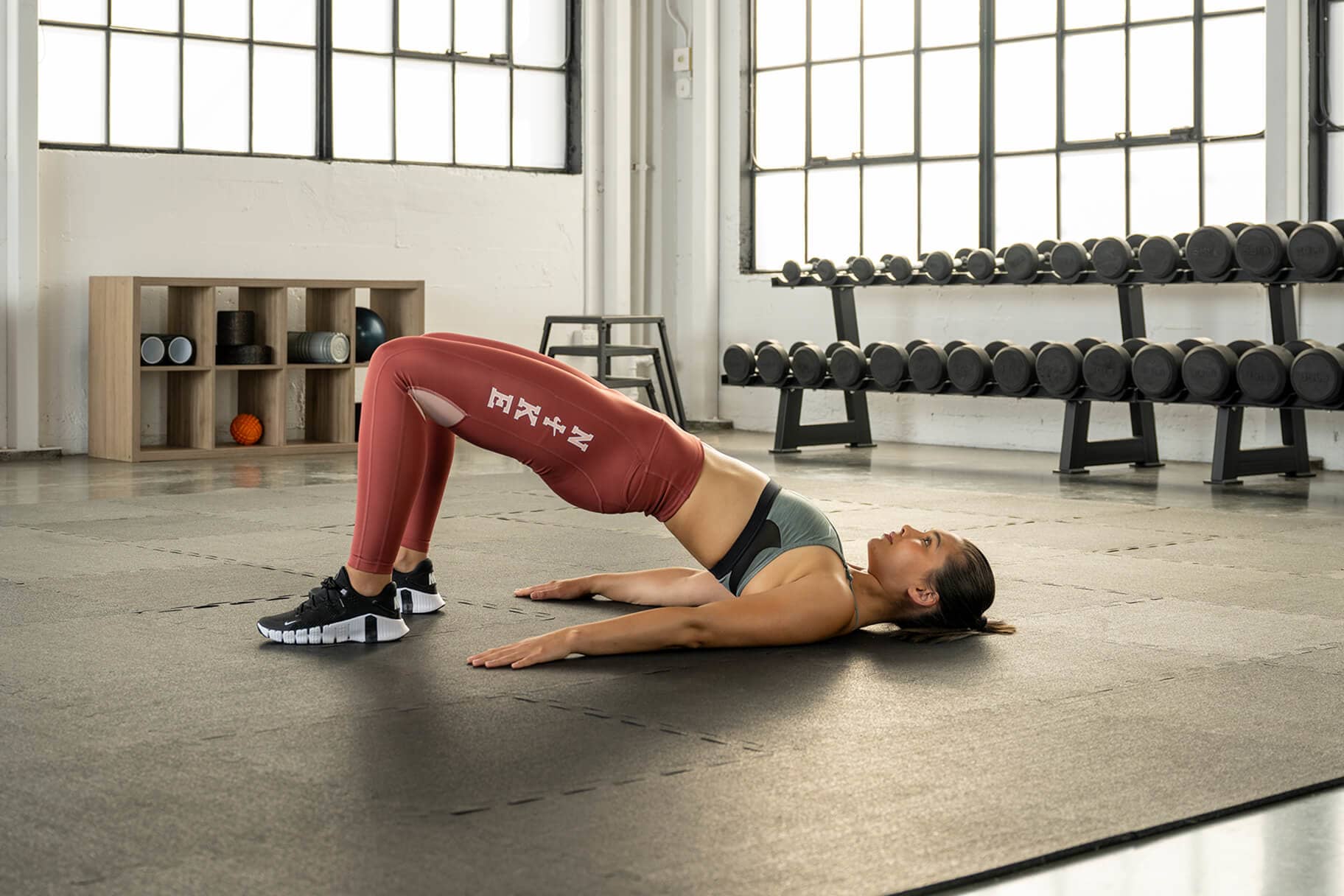
## 7. Glute bridge
True to its name, a glute bridge primarily targets the glutes – crucial for lower-body sessions – but it also engages your core and lower back muscles.
- Lie on your back with your knees bent and feet flat on the floor, hip-width apart.
- Engage your abs, push your feet into the floor and squeeze your glutes to lift your hips.
- Your knees, hips and shoulders should be aligned in the top position.
- Lower your hips to the floor with control. Do 20 to 30 reps.
- If bodyweight glute bridges aren't challenging, try looping a small resistance band around both thighs, just above the knees.
## 8. Dead bug
Similar to the bird dog exercise, this engages the deeper core muscles while also protecting the lower back, since you have more stability by being on your back.
- Lie on your back with your arms extended above your chest, knees bent and feet flat on the floor.
- Press your lower back into the floor and lift both knees until your shins are parallel to the floor.
- Tighten your abdominals and slowly lower one arm towards the floor alongside your ear while you straighten the opposite leg.
- Keep your core muscles engaged without allowing your lower back to peel off the floor.
- Return your limbs to the starting position and repeat with the opposite arm and leg. Do 20 reps in total.
## 9. Lateral mini band steps
Using a resistance band can increase the intensity of the exercise and make muscles work a little harder.
- Wrap a mini band around both thighs (just above your knees) and stand with your feet hip-width apart; you should feel mild-to-moderate tension in the band.
- Lower into a quarter-squat. Engage your outer thigh muscles and glutes to step the left foot out to the left.
- Follow with the right foot so your feet are hip-width apart again. Repeat. Do 20 steps in each direction.
## 10. Mini band monster walk
With added resistance, this move can help warm up muscles used for lateral movements.
- With the mini band still around your thighs, widen your stance so your feet are shoulder-width apart.
- Lower into a quarter-squat. Engage your outer thigh muscles and glutes, and step the left foot forwards and out to the side.
- Then, step the right foot forward and out to the side. Continue walking forwards by taking big steps, keeping your feet as wide apart as you can. Do 20 steps in total.
- Then, walk backwards in the same way. Do 20 steps in total.
## Warm-up flow
Doing some of the exercises above as a flow – rather than doing one movement for several reps and then moving on to another movement – can be useful for keeping a warm-up to 10 minutes. An easy flow might look like:
- Light cardio done without equipment, like skipping or jogging
- Stationary marching
- World's greatest stretch
- Bird dog
- Dead bug
- Glute bridge
This is a flow since you start with standing exercises, then come down to quadruped position for bird dog and end up doing two exercises on your back.
## How to shorten the warm-up to 5 minutes
Whether you're a beginner when it comes to leg day workouts or you're simply short on time, there's a way to have a speedier warm-up that's still meaningful for getting your body ready for what's ahead, says Snyder. He suggests "the lunge matrix," developed by Gary Gray, which activates muscles across all planes of motion.
The routine consists of five movements and you can do five to ten reps per movement, per leg:
- Forward lunge, keeping the torso upright
- Forward lunge with twist, which means twisting the torso toward the front leg
- Side lunge, keeping both feet pointing forward
- Angled lunge, stepping back at a 45-degree angle, sometimes called a curtsy lunge
- Backward lunge, starting from a standing position and stepping one foot backward
"This sequence provides the lower body with a full warm-up, which is why it's helpful if you don't have much time," says Snyder.
## Common warm-up mistakes
The missteps trainers tend to see most when it comes to warm-ups for leg day are:
- Going too hard on cardio
- Skipping glute activation
- Static stretching before loading
- Not rehearsing squat/hinge patterns
"Many people believe that just jumping on a bike or treadmill for five minutes is enough of a warm-up," says Snyder. "This would be true if your workout was going to cycling or jogging. The carryover of these linear cardio exercises is minimal when it comes to strength training or athletic conditioning. The more the body can warm up in all three dimensions, the better prepared the entire body's systems will be."
## FAQs
How long should a leg-day warm-up take?
This will vary depending on what you're planning as a workout, says Snyder. For example, you may be doing a "light leg day" that isn't intense and, in that case, five minutes may be enough. Or you could start a leg-day workout after doing a cardio session, which would also make the warm-up shorter. But, if you're planning a heavy leg day or you're coming to a workout from sitting all day, he suggests a longer warm-up of 15 minutes.
Should you warm up differently for heavy squats vs light leg day?
Yes, because heavy squats will put higher demand on your joints and muscles, according to Elmardi. "On a light accessory day, you might just do a quick mobility flow and get to it," he says. "But, for heavy squats, you need to build up slowly—think three to eight warm-up sets—using weight that's less than the training load."
Is stretching before leg day helpful?
Warm-ups that have some degree of stretching—such as lunges, bird dogs and glute bridges—are helpful because they activate muscles you'll be using during leg-day workouts.
What warm-up is best for knee pain?
If your knees are cranky, don't just push through it, says Elmardi. Instead, do warm-up moves that are easier on knees in general. For example, emphasise reverse lunges instead of forward lunges since those tend to be easier to control. He also suggests box squats (where you squat down to a box or chair) because they take the "bounce" out of the bottom of the movement, offering more knee protection.
Words by Elizabeth Millard
[](https://niketrainingclub.sng.link/Ara19/3ocq/gnbq?pcn=OGC%20Articles%20HO21&_dl=niketrainingclub%3A%2F%2Fx-callback-url%2Fworkout%2Ffeatured)
### Move Daily with Nike Training Club
Get free guidance from trainers and experts to strengthen your body and mind.
[Explore NTC](https://niketrainingclub.sng.link/Ara19/3ocq/gnbq?pcn=OGC%20Articles%20HO21&_dl=niketrainingclub%3A%2F%2Fx-callback-url%2Fworkout%2Ffeatured)
Originally published: 9 January 2026
## Related Stories
- 
[](https://www.nike.com/il/a/bench-press-muscles-worked)
# Sport & activity
# Everything You Need to Know About Barbell Bench Presses, According to Trainers
- 
[](https://www.nike.com/il/a/shoulder-mobility-exercises)
# Sport & Activity
# Experts Explain Why You Need To Include Shoulder Mobility Exercises Into Your Warm-up Routine
- 
[](https://www.nike.com/il/a/jump-squat-benefits)
# Sport & Activity
# Everything You Need to Know About Jump Squats
- 
[](https://www.nike.com/il/a/can-weightlifting-stunt-growth)
# Sport & Activity
# Can Weightlifting Stunt Growth? Experts Explain
- 
[](https://www.nike.com/il/a/what-muscles-do-push-ups-work-out)
# Sport & activity
# What Muscles Do Push-Ups Work? (And How To Train Them Better)
Resources
[Find a Store](https://www.nike.com/il/retail/)
[Nike Journal](https://www.nike.com/il/stories)
[Become a Member](https://www.nike.com/il/membership)
[Feedback](https://www.nike.com#site-feedback)
[Promo Codes](https://www.nike.com/il/promo-code)
[Product Advice](https://www.nike.com/il/product-advice)
[Running Shoe Finder](https://www.nike.com/il/running/shoe-finder)
Help
[Get Help](https://www.nike.com/il/help)
[Order Status](https://www.nike.com/il/orders/details)
[Shipping and Delivery](https://www.nike.com/il/help/a/shipping-delivery-gs)
[Returns](https://www.nike.com/il/help/a/returns-policy-gs)
[Payment Options](https://www.nike.com/il/help/a/payment-options-gs)
[Contact Us](https://www.nike.com/il/help/#contact)
[Reviews](https://www.nike.com/il/help/a/reviews)
Company
[About Nike](https://about.nike.com/)
[News](https://news.nike.com/)
[Careers](https://jobs.nike.com/)
[Investors](https://investors.nike.com/)
[Sustainability](https://www.nike.com/il/sustainability)
[Accessibility](https://www.nike.com/accessibility)
[Accessibility Statement](https://www.nike.com/il/accessibility/statement)
[Purpose](https://www.nike.com/il/purpose)
[Nike Coaching](https://www.nike.com/il/coaching)
[Report a concern](https://secure.ethicspoint.com/domain/media/en/gui/56821/index.html)
Community Discounts
[Student](https://urldefense.com/v3/__https://services.sheerid.com/verify/68d55e7b273c5b3a03a5b76d/?locale=en-GB__%3B%21%21KLCbKzk%21nTvDkRbY-BbSpoWsFhAQdmMrehEzU3loDux4_exRVjO9--Ik_EbQNJ3bX2gkEwR7F9cVVROFKqLxE4B8uW6bnx4IPOiRLg%24)
[Teacher](https://urldefense.com/v3/__https://services.sheerid.com/verify/68dcfa39c3f2fd1cd3069932/?locale=en-GB__%3B%21%21KLCbKzk%21nTvDkRbY-BbSpoWsFhAQdmMrehEzU3loDux4_exRVjO9--Ik_EbQNJ3bX2gkEwR7F9cVVROFKqLxE4B8uW6bnx5n4vwR-Q%24)
[Resources](https://www.nike.com/il/help)
[Find a Store](https://www.nike.com/il/retail/)
[Nike Journal](https://www.nike.com/il/stories)
[Become a Member](https://www.nike.com/il/membership)
[Feedback](https://www.nike.com#site-feedback)
[Promo Codes](https://www.nike.com/il/promo-code)
[Product Advice](https://www.nike.com/il/product-advice)
[Running Shoe Finder](https://www.nike.com/il/running/shoe-finder)
[Help](https://www.nike.com/il/help)
[Get Help](https://www.nike.com/il/help)
[Order Status](https://www.nike.com/il/orders/details)
[Shipping and Delivery](https://www.nike.com/il/help/a/shipping-delivery-gs)
[Returns](https://www.nike.com/il/help/a/returns-policy-gs)
[Payment Options](https://www.nike.com/il/help/a/payment-options-gs)
[Contact Us](https://www.nike.com/il/help/#contact)
[Reviews](https://www.nike.com/il/help/a/reviews)
[Company](https://about.nike.com/en)
[About Nike](https://about.nike.com/)
[News](https://news.nike.com/)
[Careers](https://jobs.nike.com/)
[Investors](https://investors.nike.com/)
[Sustainability](https://www.nike.com/il/sustainability)
[Accessibility](https://www.nike.com/accessibility)
[Accessibility Statement](https://www.nike.com/il/accessibility/statement)
[Purpose](https://www.nike.com/il/purpose)
[Nike Coaching](https://www.nike.com/il/coaching)
[Report a concern](https://secure.ethicspoint.com/domain/media/en/gui/56821/index.html)
## Community Discounts
[Student](https://urldefense.com/v3/__https://services.sheerid.com/verify/68d55e7b273c5b3a03a5b76d/?locale=en-GB__%3B%21%21KLCbKzk%21nTvDkRbY-BbSpoWsFhAQdmMrehEzU3loDux4_exRVjO9--Ik_EbQNJ3bX2gkEwR7F9cVVROFKqLxE4B8uW6bnx4IPOiRLg%24)
[Teacher](https://urldefense.com/v3/__https://services.sheerid.com/verify/68dcfa39c3f2fd1cd3069932/?locale=en-GB__%3B%21%21KLCbKzk%21nTvDkRbY-BbSpoWsFhAQdmMrehEzU3loDux4_exRVjO9--Ik_EbQNJ3bX2gkEwR7F9cVVROFKqLxE4B8uW6bnx5n4vwR-Q%24)
Israel
- © 2026 Nike, Inc. All rights reserved.
- Guides
- [Nike Air](https://www.nike.com/il/air)
- [Nike Air Max](https://www.nike.com/il/air-max)
- [Nike FlyEase](https://www.nike.com/il/flyease)
- [Nike Pegasus](https://www.nike.com/il/running/runningzoom-pegasus-37)
- [Nike React](https://www.nike.com/il/react)
- [Nike Vaporfly](https://www.nike.com/il/running/vaporfly)
- [Terms of Use](https://agreementservice.svs.nike.com/il/en_gb/rest/agreement?agreementType=termsOfUse&uxId=com.nike.unite&country=IL&language=en&requestType=redirect)
- [Terms of Sale](https://www.eshopworld.com/terms-and-conditions-of-sale-en/)
- [Company Details](https://www.nike.com/il/help/a/company-details)
- [Privacy & Cookie Policy](https://agreementservice.svs.nike.com/il/en_gb/rest/agreement?agreementType=privacyPolicy&uxId=com.nike.unite&country=IL&language=en&requestType=redirect)
- [Privacy & Cookie Settings](https://www.nike.com/il/en/guest/settings/privacy)
## Africa
- [__Egypt__
\
English](https://www.nike.com/eg/)
- [__Morocco__
\
English](https://www.nike.com/ma/en/)
- [__Maroc__
\
Français](https://www.nike.com/ma/)
- [__South Africa__
\
English](https://www.nike.com/za/)
## Americas
- [__Argentina__
\
Español](https://www.nike.com.ar)
- [__Brasil__
\
Português](https://www.nike.com.br)
- [__Canada__
\
English](https://www.nike.com/ca/)
- [__Canada__
\
Français](https://www.nike.com/ca/fr/)
- [__Chile__
\
Español](https://www.nike.cl)
- [__Colombia__
\
Español](https://www.nike.com.co)
- [__México__
\
Español](https://www.nike.com/mx/)
- [__Peru__
\
Español](https://www.nike.com.pe)
- [__Puerto Rico__
\
Español](https://www.nike.com/pr/)
- [__United States__
\
English](https://www.nike.com)
- [__Estados Unidos__
\
Español](https://www.nike.com/us/es/)
- [__Uruguay__
\
Español](https://www.nike.com.uy)
- [__Latin America__
\
Español](https://www.nike.com/xl/)
## Asia Pacific
- [__Australia__
\
English](https://www.nike.com/au/)
- [__中国大陆__
\
简体中文](https://www.nike.com.cn/)
- [__Hong Kong__
\
English](https://www.nike.com.hk/)
- [__香港__
\
繁體中文](https://www.nike.com.hk/)
- [__India__
\
English](https://www.nike.in/)
- [__Indonesia__
\
English](https://www.nike.com/id/)
- [__Japan__
\
English](https://www.nike.com/jp/en/)
- [__日本__
\
日本語](https://www.nike.com/jp/)
- [__대한민국__
\
한국어](https://www.nike.com/kr/)
- [__Malaysia__
\
English](https://www.nike.com/my/)
- [__New Zealand__
\
English](https://www.nike.com/nz/)
- [__Philippines__
\
English](https://www.nike.com/ph/)
- [__Singapore__
\
English](https://www.nike.com/sg/)
- [__台灣__
\
繁體中文](https://www.nike.com/tw/)
- [__ไทย__
\
ภาษาไทย](https://www.nike.com/th/)
- [__Vietnam__
\
English](https://www.nike.com/vn/)
## Europe
- [__Österreich__
\
Deutsch](https://www.nike.com/at/)
- [__Austria__
\
English](https://www.nike.com/at/en/)
- [__Belgien__
\
Deutsch](https://www.nike.com/be/de/)
- [__Belgium__
\
English](https://www.nike.com/be/en/)
- [__Belgique__
\
Français](https://www.nike.com/be/fr/)
- [__België__
\
Nederlands](https://www.nike.com/be/)
- [__Bulgaria__
\
English](https://www.nike.com/bg/)
- [__Croatia__
\
English](https://www.nike.com/hr/)
- [__Česká republika__
\
Čeština](https://www.nike.com/cz/)
- [__Czech Republic__
\
English](https://www.nike.com/cz/en/)
- [__Danmark__
\
Dansk](https://www.nike.com/dk/)
- [__Denmark__
\
English](https://www.nike.com/dk/en/)
- [__Finland__
\
English](https://www.nike.com/fi/)
- [__France__
\
Français](https://www.nike.com/fr/)
- [__Deutschland__
\
Deutsch](https://www.nike.com/de/)
- [__Ελλάδα__
\
ελληνικά](https://www.nike.com/gr/)
- [__Hungary__
\
English](https://www.nike.com/hu/en/)
- [__Magyarország__
\
Magyar](https://www.nike.com/hu/)
- [__Ireland__
\
English](https://www.nike.com/ie/)
- [__Israel__
\
English](https://www.nike.com/il/)
- [__Italia__
\
Italiano](https://www.nike.com/it/)
- [__Luxemburg__
\
Deutsch](https://www.nike.com/lu/de/)
- [__Luxembourg__
\
English](https://www.nike.com/lu/en/)
- [__Luxembourg__
\
Français](https://www.nike.com/lu/)
- [__Netherlands__
\
English](https://www.nike.com/nl/en/)
- [__Nederland__
\
Nederlands](https://www.nike.com/nl/)
- [__Norway__
\
English](https://www.nike.com/no/en/)
- [__Norge__
\
Norsk](https://www.nike.com/no/)
- [__Polska__
\
Polski](https://www.nike.com/pl/)
- [__Portugal__
\
English](https://www.nike.com/pt/en/)
- [__Portugal__
\
Português](https://www.nike.com/pt/)
- [__Romania__
\
English](https://www.nike.com/ro/)
- [__Россия__
\
Русский](https://www.nike.com/ru/)
- [__Slovakia__
\
English](https://www.nike.com/sk/)
- [__Slovenia__
\
English](https://www.nike.com/si/)
- [__Espanya__
\
Català](https://www.nike.com/es/ca/)
- [__España__
\
Español](https://www.nike.com/es/)
- [__Sweden__
\
English](https://www.nike.com/se/en/)
- [__Sverige__
\
Svenska](https://www.nike.com/se/)
- [__Schweiz__
\
Deutsch](https://www.nike.com/ch/)
- [__Switzerland__
\
English](https://www.nike.com/ch/en/)
- [__Suisse__
\
Français](https://www.nike.com/ch/fr/)
- [__Svizzera__
\
Italiano](https://www.nike.com/ch/it/)
- [__Türkiye__
\
Türkçe](https://www.nike.com/tr/)
- [__United Kingdom__
\
English](https://www.nike.com/gb/)
## Middle East
- [__Saudi Arabia__
\
English](https://www.nike.sa/en/home)
- [__المملكة العربية السعودية__
\
العربية](https://www.nike.sa/ar/home)
- [__United Arab Emirates__
\
English](https://www.nike.ae/en/home)
- [__الإمارات العربية المتحدة__
\
العربية](https://www.nike.ae/ar/home)
- [__Qatar__
\
English](https://www.nike.qa/en/home)
- [__دولة قطر__
\
العربية](https://www.nike.qa/ar/home)
- [__Kuwait__
\
English](https://www.nike.com.kw/en/home)
- [__الكويت__
\
العربية](https://www.nike.com.kw/ar/home)